
Douglas County Arrest Records and Court Charges
Douglas County arrest records are created on the law-enforcement side when a person is arrested, brought to the jail, booked, photographed, fingerprinted, and processed. The Sheriff's research says arrestees are brought to the jail at the Justice Center, interviewed while paperwork is completed, photographed, fingerprinted, and given a mouth-swab DNA sample. During booking, the person may make limited free phone calls. If no bond is allowed, the inmate is seen by a judge or magistrate the following day.
Court charges after arrest are different. The 23rd Judicial District Attorney decides what formal charges to file after law enforcement investigation or arrest. Once charges are filed, they are tracked through the court case. The full criminal case file and final sentencing details live in Douglas County criminal court records, while custody and booking details belong with inmate and sheriff records. One arrest can lead to no charges, one charge, multiple charges, amended charges, or charges that later get dismissed.
The Sheriff's records-request page is the researched source for Douglas County arrest reports, citations, jail records, and related CJRA requests.
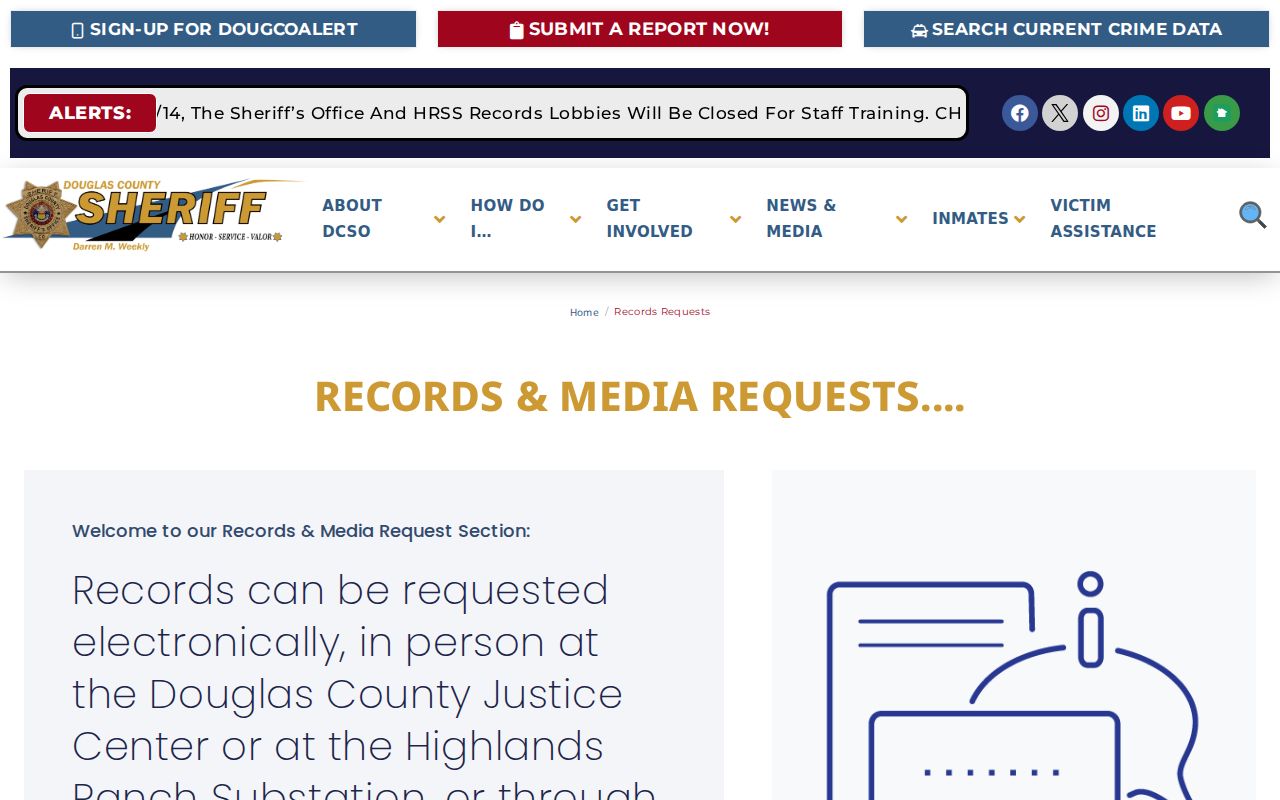
Use the Sheriff's records channel for arrest reports and jail records, then use court channels for filed charges and case outcomes.
Booking Charges vs Court Charges
A booking charge is the arrest or custody basis recorded during intake. It can reflect what the deputy, officer, or arresting agency believed at the time of arrest. A court charge is the formal accusation filed with the court. The two can differ because the prosecutor reviews facts, evidence, severity, criminal history, victim input, and legal requirements before filing or amending charges.
| Arrest or Booking Record | Court Charge Record | |
|---|---|---|
| Created by | Law enforcement and jail staff. | Prosecutor and court clerk. |
| Shows | Booking, custody, bond, arrest basis, and public jail details. | Complaint, information, charge codes, hearings, amendments, and disposition. |
| Main Douglas County source | Sheriff records request or inmate inquiry. | Colorado court docket, records request, and Clerk of Court. |
| Best use | Confirm arrest, custody, jail record, or report request. | Confirm what was filed and how each charge changed. |
The Sheriff's booking-process source explains how an arrestee moves from arrest into jail intake.
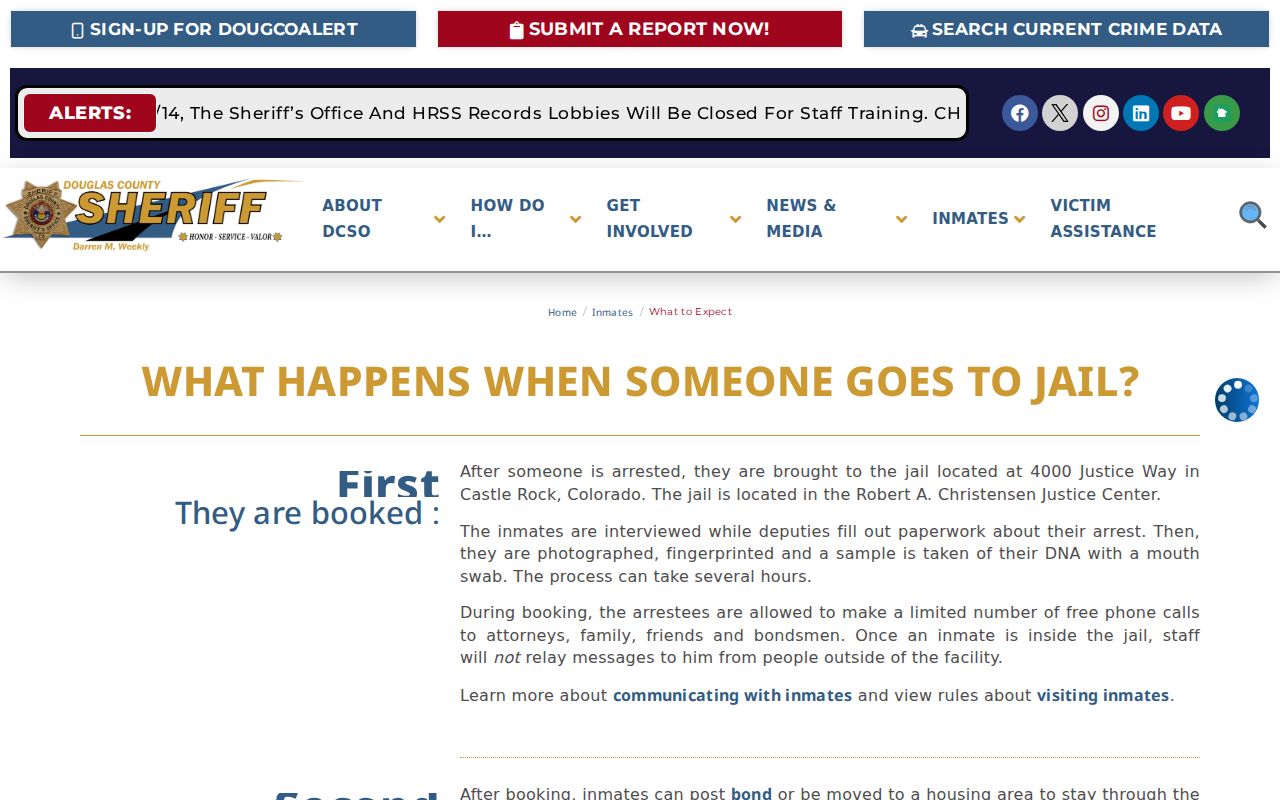
That process is the custody side of the record, not the final court charge history.
Find Douglas County Arrest Records and Charges
Use a source chain. Start with the Sheriff's Office when the need is an arrest report, citation, jail record, medical jail record, or incident report. The Sheriff's research lists electronic requests, in-person requests at the Justice Center or Highlands Ranch Substation, U.S. mail, general records phone 303-660-7545, and CJRA@dcsheriff.net. Then use court dockets or court records requests when the need is the filed charge, court date, disposition, or sentencing record.
- Check whether the person was booked or is in custody through the official sheriff custody tools and records channels.
- Request the arrest report or jail record through the Sheriff's CJRA records process when a law-enforcement document is needed.
- Use the Colorado Judicial Branch docket search for court dates, case numbers, and filed charge events.
- Request the complaint, information, disposition, or sentencing order from the Douglas County Clerk of Court if a court document is needed.
- Check municipal courts separately if the charge is a local ordinance or municipal traffic matter.
For public criminal-history checks, the Colorado Bureau of Investigation has a statewide ICHC system. It is separate from the court case file and separate from a Sheriff's arrest report.
The Sheriff's Office and the court may both have useful records from the same incident, but they answer different questions. The Sheriff's record can document the arrest, citation, booking, or report request. The court record can document whether the prosecutor filed charges, whether the defendant appeared, whether bond or a warrant was addressed, and how each charge ended. For a certified disposition, the court channel is the correct source.
Charging Documents After Arrest
The charge record begins when a charging document reaches court. The Douglas County research identifies criminal files as including complaint or information, advisement, bond, plea, motions, disposition, sentence, probation terms, restitution, fines, and warrant activity. Complaint, information, and indictment are the terms a reader is most likely to see in the charge path, though not every case uses each one.
| Document | Who Files or Initiates It | Common Use | What It Starts or Defines |
|---|---|---|---|
| Complaint | Prosecutor or law-enforcement based filing process. | Misdemeanor, county-court, or early criminal charge filings. | Names the charge and starts or supports the court case. |
| Information | Prosecutor. | Many felony prosecutions in District Court. | States the formal felony charge without requiring a grand jury indictment. |
| Indictment | Grand jury process. | Serious or complex criminal matters when used. | Formal accusation returned through grand jury procedure. |
These terms describe accusations, not proof. The court record must be read through disposition and sentence to know the result.
Douglas County Charge Status Table
Charges can change after filing. A prosecutor may amend, add, reduce, or dismiss a count. The court may record a plea to one count while dismissing another. A failure to appear can add warrant activity to the same case record. Charge status should be checked by count because one case can have several different results.
| Status | What It Means | Where It May Appear |
|---|---|---|
| Pending | The charge is still open and has not reached final disposition. | Docket, register of actions, hearing calendar. |
| Amended | The filed charge was changed after review, plea negotiation, or court action. | Docket entry, amended complaint or information. |
| Reduced | The charge level or offense was lowered, often as part of plea or amendment. | Disposition entry, plea paperwork, sentencing order. |
| Dismissed | The charge was dropped by court order or prosecutor action. | Disposition or order entry. |
| Warrant active or cleared | A warrant was issued or resolved during the case, often from failure to appear. | Docket, warrant entry, sheriff or court records. |
Charges vs Convictions
Being charged is not the same as being convicted. Douglas County arrest records can show why a person entered custody, and court records can show what the prosecutor filed, but a conviction requires a guilty plea, verdict, or other court result that establishes guilt on a charge. Always read the final disposition for each count.
| Charge | Conviction | |
|---|---|---|
| Timing | Appears after arrest or filing. | Appears after plea or verdict. |
| Meaning | Formal accusation or arrest basis. | Final guilt result on a count. |
| Can change | Yes, it may be amended, reduced, or dismissed. | The sentence or sealing status can later affect public visibility. |
| Best source | Charging document and docket. | Disposition, judgment, and sentencing order. |
Statewide Charge and Custody Lookups
State systems answer different questions. The CBI criminal-history system is for statewide criminal-history checks. The Colorado DOC offender search is for state-prison offenders, not people newly booked into the Douglas County Jail. The Colorado sex offender registry is a separate DPS/CBI search and should not be treated as a court charge list. Each source can help verify a different stage of the criminal justice process.
The Colorado DOC offender search is a post-sentence custody source, not a Douglas County arrest record database.
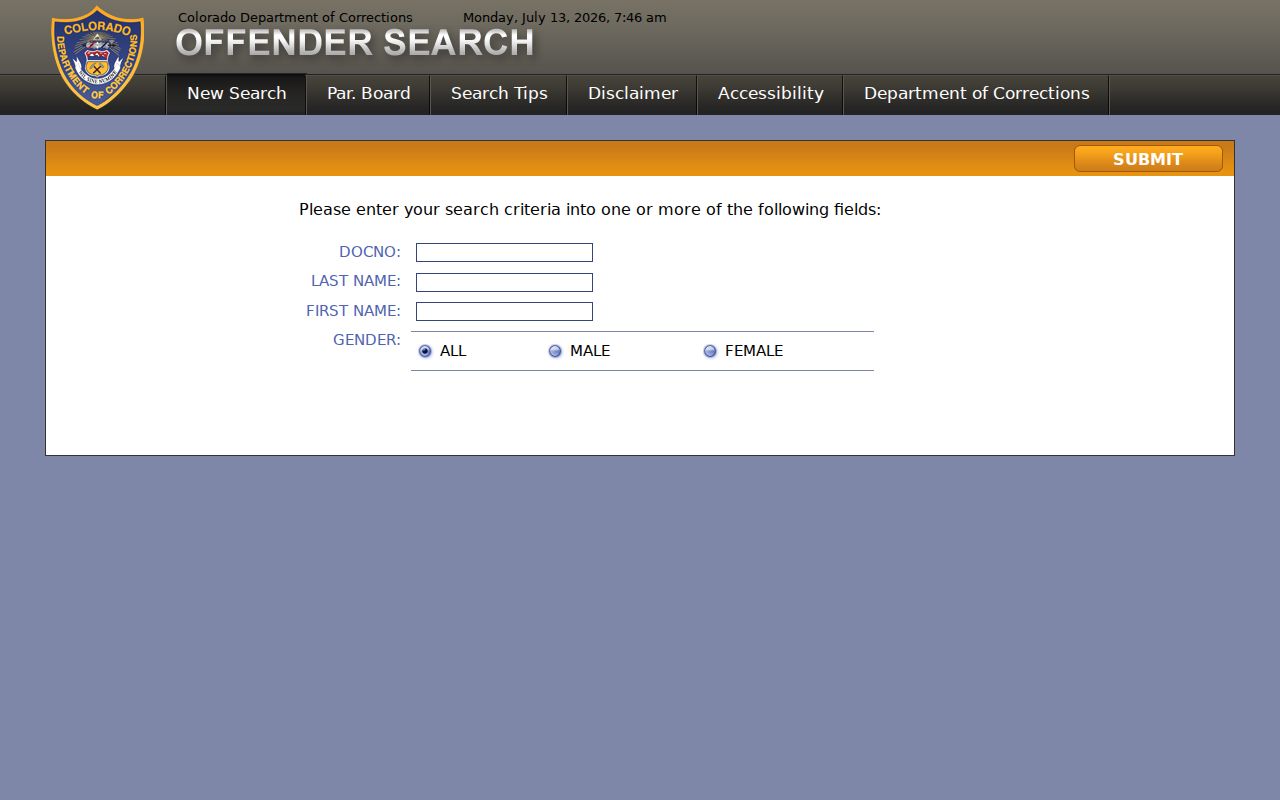
Use the DOC search after prison transfer or sentencing, while local jail and court records remain separate.
The Colorado sex offender registry is assigned to this record path because some conviction outcomes create later registration records.
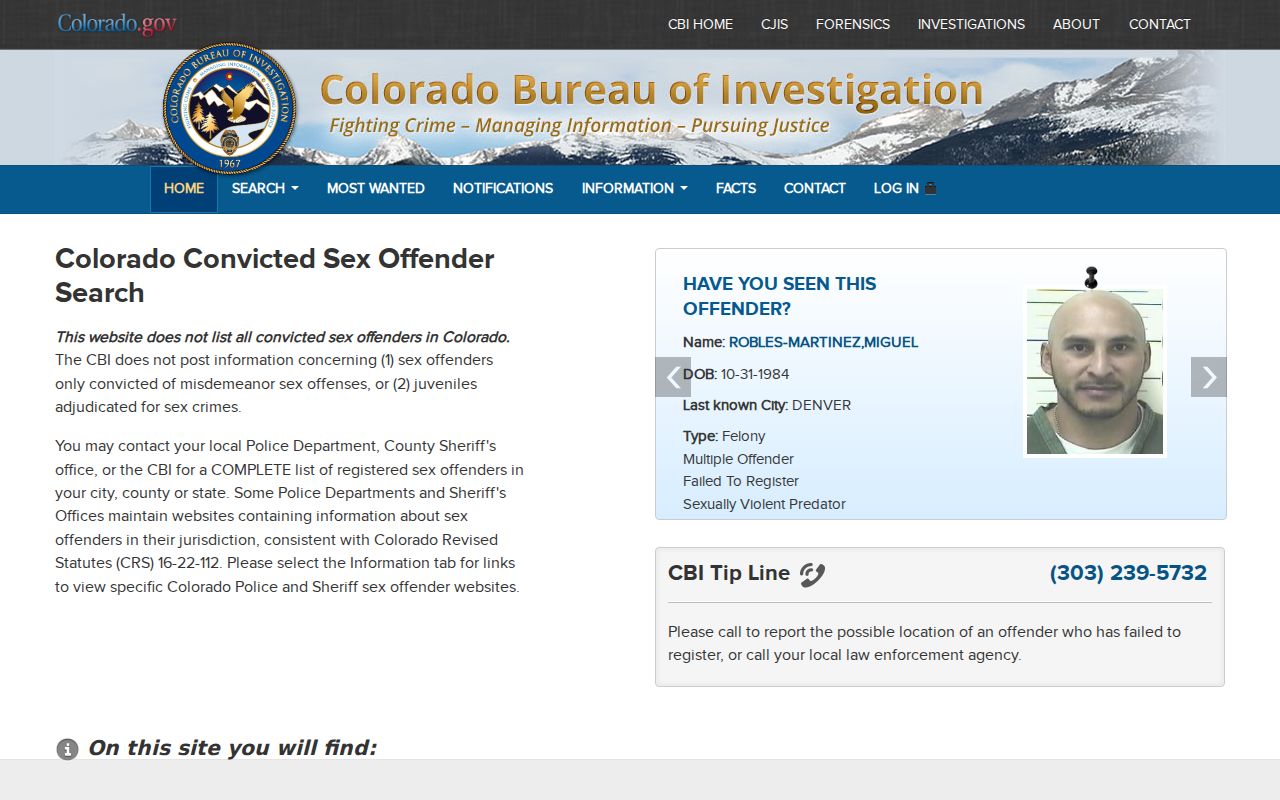
Registry data should be checked as a statutory registration source, not as proof of every charge filed in Douglas County court.
Sealed Arrest Records and Charges
Colorado law allows qualifying arrest and non-conviction records to be sealed automatically or by motion. The research cites C.R.S. 24-72-704 and related sealing statutes, C.R.S. 13-3-117 for automatic sealing confirmation, and Judicial Branch sealing forms for conviction, non-conviction, municipal, and multiple-case records. Juvenile records have separate confidentiality and expungement protections under Title 19.
| Sealed | Expunged | |
|---|---|---|
| Public effect | Hidden from ordinary public access. | Removal-style treatment, often linked to juvenile record law. |
| Common Douglas County context | No-charge arrest, non-conviction, eligible conviction, or municipal sealing process. | Juvenile cases or specific statutory paths. |
| Still available to | Courts, law enforcement, prosecutors, and other authorized users may retain access. | Access depends on the expungement statute and court order. |
The CBI sealing-of-arrests source explains the state-level handling of court-ordered sealing for arrest records.
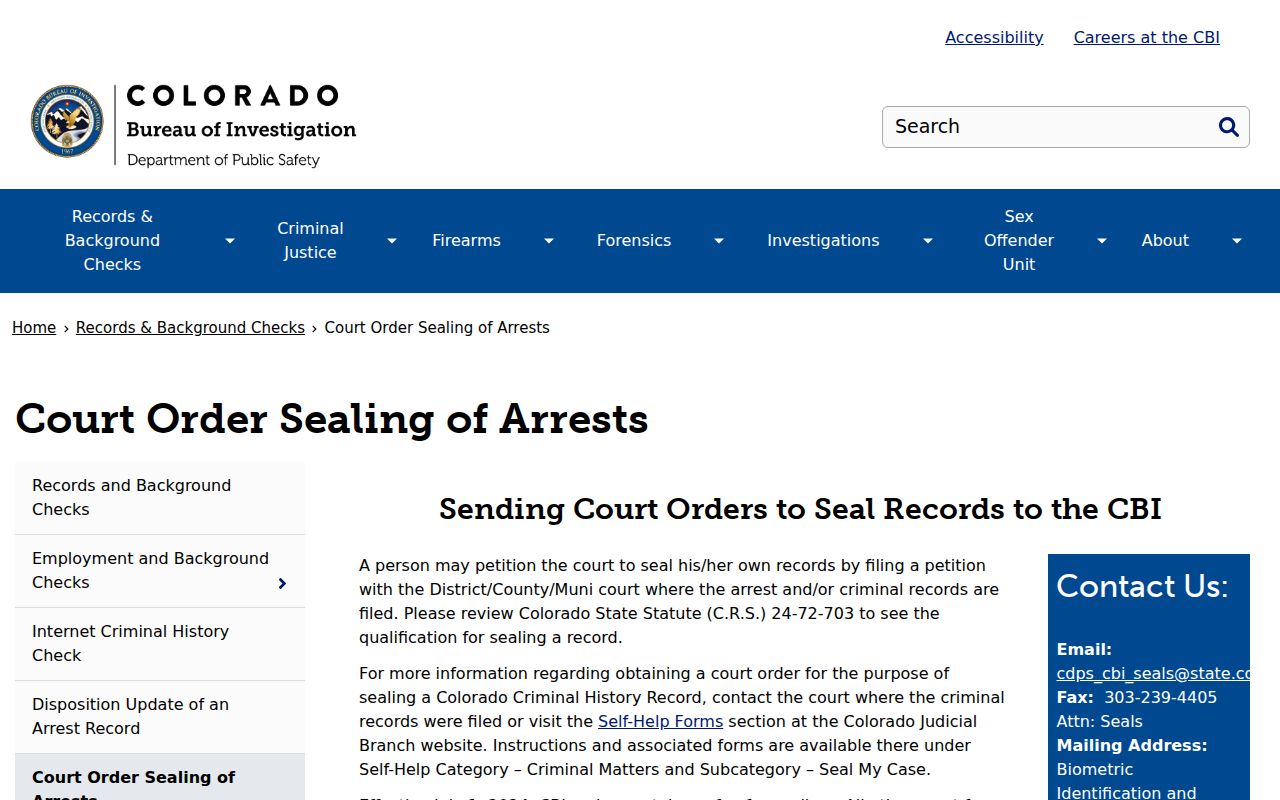
Sealing can restrict public access to an arrest or charge record, but the correct route depends on how the case ended.
Douglas County Charge Record Offices
The Douglas County Sheriff's Office handles arrest reports, jail records, citations, and law-enforcement records through its records process. The Douglas County Clerk of Court handles case-file requests after charges are filed in District Court or County Court. The 23rd Judicial District Attorney files and prosecutes criminal charges, with a Douglas County office at 4000 Justice Way, Suite 2525-A, Castle Rock, CO 80109-7570, phone 720-733-4500. The Public Defender regional office is at 1161 S. Perry Street, Suite 200, Castle Rock, CO 80104, phone 303-688-3081.
Charge records can also appear in municipal cases. Castle Rock handles traffic, parking, animal, and misdemeanor municipal offenses within town limits. Parker and Foxfield summons may route to Parker Municipal Court based on the summons color noted in the research. Lone Tree handles traffic, misdemeanor, parking, animal, and municipal code cases. If the charge is municipal, a state court search may not show the full event path.
Note: Send arrest reports to the Sheriff, filed charge documents to the court, and prosecution questions to DA23.